Why background removal is everywhere
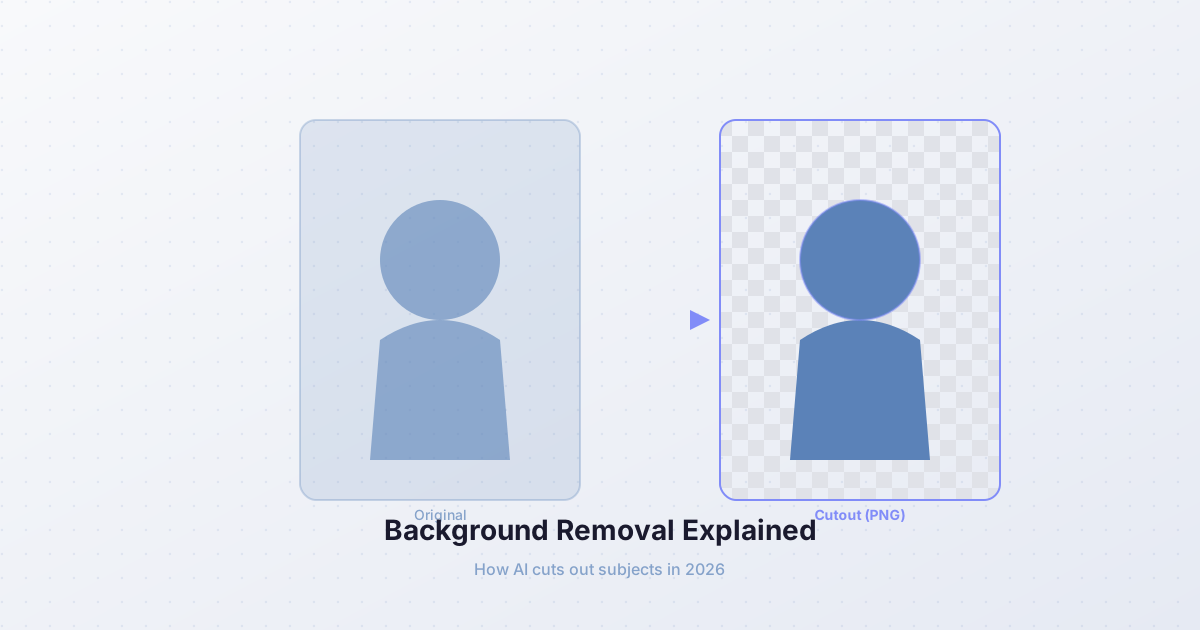
Every product photo on Amazon, every profile headshot, every sticker in your chat app — they all started as a rectangular photo with a background. The background was removed by software. In 2026, this happens so fast and so cheaply that we forget it is a hard problem.
A decade ago, removing a background meant opening Photoshop, zooming to 400%, and manually tracing the subject with the Pen tool — 30 minutes per photo, and the result still had a green fringe around the hair. Today, a browser can do it in 1 second, for free, with better quality. The question is: how?
The three algorithms
Every modern background remover — whether it is remove.bg, Canva, Photoshop, or a browser-based tool — uses one of three approaches, or a combination of them.
1. Color-based segmentation
The simplest method. The algorithm samples the colors at the four corners of the image (assumed to be background), builds a color model, and marks every pixel that is "close enough" to that model as background. The tolerance threshold controls how aggressive the removal is.
This works perfectly for a product on a white background, a person against a blue sky, or anything shot on a green screen. It fails when the background has multiple colors (a tree, a crowd, a textured wall) or when the subject is similar in color to the background (a white cat on a white couch).
2. Flood-fill with alpha matting
The second method. The algorithm builds a trimap — a rough map with three zones: definitely foreground, definitely background, and the "unknown" zone at the edge. It then runs flood-fill from the known zones into the unknown zone, computing a soft alpha value (0 to 1) for each edge pixel based on how much foreground vs background color it contains.
This is where CIELab color space comes in. RGB distance does not match how humans perceive color — two greens with the same RGB distance can look identical or totally different. CIELab (Lightness, a, b) is perceptually uniform: equal distances in Lab space look equally different. Background removers that use CIELab produce cleaner edges because they make better decisions about which side of the boundary a pixel belongs to.
3. AI semantic segmentation
The third method. A neural network — typically a U-Net or similar encoder-decoder architecture — is trained on millions of labeled images. It learns to recognize "person", "car", "dog", "product" as semantic categories, and produces a pixel-accurate mask of the subject regardless of the background.
For photos with people, MediaPipe Selfie Segmentation (a lightweight model from Google) runs in real-time in the browser, no GPU required. For products and objects, heavier models like U²-Net or IS-Net are used. The tradeoff is quality vs speed vs model size: a 40 MB model gives near-perfect hair, but takes 5 seconds to download. A 2 MB model is instant but struggles with fine details.
Why hair is the hardest problem
Hair is the nemesis of background removal. A single strand of hair is 1-2 pixels wide — below the resolution of most masks. Semi-transparent hair mixes foreground and background colors in ways that no hard threshold can separate. And the visual difference between "good hair cutout" and "bad hair cutout" is enormous — a green halo around the head instantly screams "fake".
The solution is alpha matting combined with color decontamination. Alpha matting computes a soft alpha value for each pixel, so hair strands fade gradually into transparency instead of ending in a hard line. Color decontamination inverts the compositing equation — foreground = (composite - (1-alpha) × background) / alpha — to recover the true foreground color at edge pixels, removing the green (or blue, or gray) tint that bleeds in from the background.
The pipeline
A production-grade background remover runs all three methods in sequence:
- Color segmentation — fast first pass, marks obvious background pixels.
- Flood-fill + alpha matting — refines the edge, computes soft alpha values.
- Color decontamination — removes the halo from semi-transparent edge pixels.
- Connected-component analysis — keeps only the largest subject region, removes floating noise islands.
For photos with people, step 0 is AI selfie segmentation — it gives a head start on the mask, so the color and flood-fill passes have less work to do.
When it fails
Background removal fails when:
- The subject is similar in color to the background. A white shirt on a white wall, a green lizard on a green leaf. The algorithm cannot find an edge because, perceptually, there is no edge.
- The background is complex and busy. Trees, crowds, chain-link fences — too many colors for a flood-fill to handle.
- The subject is transparent or reflective. Glass, water, plastic — the "foreground" is partly background.
- The image is low resolution. At 200×200, a strand of hair is 0.5 pixels — below the sampling limit.
How to get the best results
- Shoot against a uniform background. White, gray, or blue works best. The further the background color is from the subject, the cleaner the cutout.
- Use a high-resolution source. 2000×2000 or larger. The algorithm needs pixels to work with at the edge.
- Avoid motion blur. A blurred edge is a wide "unknown" zone that the algorithm has to guess.
- For hair, use a plain background. Patterned backgrounds bleed into hair and create halos that are hard to remove.
Privacy
Background removal can run entirely in the browser. No image is uploaded, no server sees the photo. The algorithm — color segmentation, flood-fill, even the AI model — runs on the device's CPU or GPU. This is safe for private photos, family portraits, ID photos, and any sensitive images.
The future
The next frontier is real-time background removal on video — Zoom, Meet, and OBS already do this with varying quality. The algorithms are the same; the challenge is running them at 30-60 frames per second. Browser-based tools are catching up: with WebGPU, real-time 4K background removal in a browser tab is becoming feasible.
For photos, the problem is essentially solved. The algorithms are good enough, fast enough, and free enough that "remove the background" is a one-click operation. The remaining work is at the edges — literally: hair, fur, and semi-transparent materials still challenge every algorithm, and probably always will.